
One lucky borsista
Written by 2026 October Scholar John LaManna
I arrived in Piazza Partigiani about 6:30 pm after two sleepless flights and a long bus ride. After wandering around for about 15 minutes with a lot of luggage, I found the taxi stand. There were no taxis but there was a taxi sign with telephone and WhatsApp numbers. I called. Ten minutes later a taxi arrived.
My destination: via Bontempi, a ZTL in the centro storico. The taxi driver refused to take me any further than Piazza Piccinino, located at one end of Bontempi. He told me the apartment was only 100 meters further. So off I went into the fading daylight with my wheeled luggage on the rough sandstone pavement of via Bontempi.
The address numbers were hard to see. I reached a travertine arch and descended a long curved stairway. When I reached the bottom, the street lights came on and I discovered I had gone too far. So I went back up the stairs. About half way up, I encountered a young Italian man going in the opposite direction. He stopped and asked if he could help me. How nice is that?
Below is a photo of the stairway near the entrance to my building.

I found my apartment and was warmly welcomed by my host, Maria Rita. My Italian was good enough that we had a very pleasant conversation for about 20 minutes. In spite of my jet lag, I was feeling good about my host and being in Perugia. When it comes down to why I wanted to attend the Università per Stranieri di Perugia (Unistrapg), it was because I envied those people I’ve met over the years who had done this. These were people I respected for their commitment to learning Italian and immersing themselves in the culture. I’ve attended private Italian language schools before. But Unistrapg turned out to be a better school for me because of how Unistrapg organizes its semesters. Private schools often have to rearrange classes on Mondays because new students arrive and some existing students leave. The changing student body make it difficult for the teachers to follow a curriculum.
Unistrapg is organized around a 3-month semester and a one-month minimum enrollment. As a result, I have made much faster progress at Unistrapg. It is really a university experience. I was placed in the B1 language proficiency group based on my entrance exam results. Near the end of the first week, it was obvious to me that I should move up a level. I asked and was allowed. The next level, B2, was the right one. While it took some time to get everything sorted, at the end, my teacher complimented me on my patience. What I learned was to smile, be polite, and be gently persistent.
Below is a photo of the fossiliferous limestone on the walls of Unistrapg’s Aula Magna. Unistrapg’s building has many beautiful and interesting architectural details such as this.

One of my pleasures in Perugia is learning my way around the centro storico. It is a three-dimensional maze of narrow winding streets, ZTLs, long curved stairways, arches, tunnels, escalators and elevators. The ninety-degree angle has been used sparingly over the centuries. One consequence of this maze is there are not a lot of automobiles, motorcycles and bicycles in the centro storico. This enhances the tranquility of the historical neighborhoods and pleasures of walking or relaxing outside. Below a photo of the entrance of via Volte della Pace. The name refers to a peace treaty the Etruscans negotiated here and the vaulted medieval ceiling. This is a typical street in the centro storico.
 I’ve been patronizing Osteria Il Gufo. This restaurant is operated by Luca Pisauri, an affable man. Luca was part of our sister city exchange in 1997. I attended a cooking demonstration he did at the (former) downtown Seattle Bon Marche department store. It was in the kitchen department on the third floor. He cooked on a stove with a mirror for the audience. It was standing room only. He prepared Umbrian dishes using ingredients that he had brought, like truffles.

I approached Luca and told him I would be in Perugia the following year and I would very much like to celebrate my pop 50th birthday at his restaurant. He gave me his card. The following year I showed up at his restaurant a few days before my birthday and before the restaurant was open for diners. We discussed some dishes and agreed on a price (it was in lira then). Luca told me to arrive at 8 PM on my birthday. I arrived with my wife and another couple. Luca did not disappoint. It was one of my most memorable birthdays. And it wasn’t all about the food. Luca really enjoyed making it a celebration. He knew just what to do. I have been buying my “good” olive oil for many years from San Potente, an agriturismo near Assisi. It is a quality product. I contacted the owner and asked if I could watch the harvest and milling during my month in Perugia. The owner agreed but put me to work as soon as I arrived. I lasted only about 20 minutes using the power shaker tool on the trees. I did much better helping with the preliminary cleaning of the olives. A box of olives is poured into the hopper of fan-cleaning machine. I removed twigs and leaves from the hopper while olives fell out of the bottom of the hopper and through an airstream that blew away the leaves from the olives. I did this for about two hours. Below. a photo of me helping remove leaves and twigs from olives.

The best part came next. We took the day’s harvest to a mill (frantoio) in Foligno. This was a busy place because it was the weekend and small family farms as well as businesses like San Potente were arriving with their olives. I saw people helping each other unload boxes of olives. A few people brought their kids. San Potente brought their day’s harvest of olives in 4 tub skids (large forklift boxes). Small family farms brought their olives in boxes about the size of bankers’ boxes. They had their little cars filled with boxes of olives - even on the front seat. These they poured into tub skids at the mill. The people working at the mill carefully labeled all the tub-skids. It is very important to keep everyone’s olives and oil separate. The mill weighed the tub skids and gave the owners receipts. The mill charges the owners by this weight. Next, one owner’s tub skids are dumped into the hopper of a conveyor belt. This is done only after the previous owner’s olives have been milled and the hopper is empty. The olives go through another blower to remove leaves, are washed with water, and are fed in batches into an extractor called a gremola (accent on first syllable). This machine has an auger with paddles that churns the olives into a paste. This kneading process lasts about 20 minutes during which the olives release their oil and the oil drops coalesce. Next, the pulp goes into the first centrifuge. This separates the solids from the liquids. The liquid portion then goes to the second centrifuge. This separates the olive oil from the water. The olive oil is collected, weighed, and poured into a vat with the owner’s name on it. The weight of the oil is used to calculate the yield. The olives from San Potente that day had a 16% yield: pretty good. Attention is paid to quality. San Potente is proud of the olive oil they produce. By extracting it the same day the olives are harvested, there is almost no acidity. The mill does not allow the olive oil to get too warm during the milling. Owners’ olives and oils are meticulously kept separate. Everyone seemed to know each other and appeared to work in harmony. The San Potente person I was with watched everything from the time his olives arrived until the last drop of oil was captured and weighed. Below a photo of me with a bottle of olive oil from olives harvested earlier the same day. The oil is cloudy because it hasn’t yet been filtered.
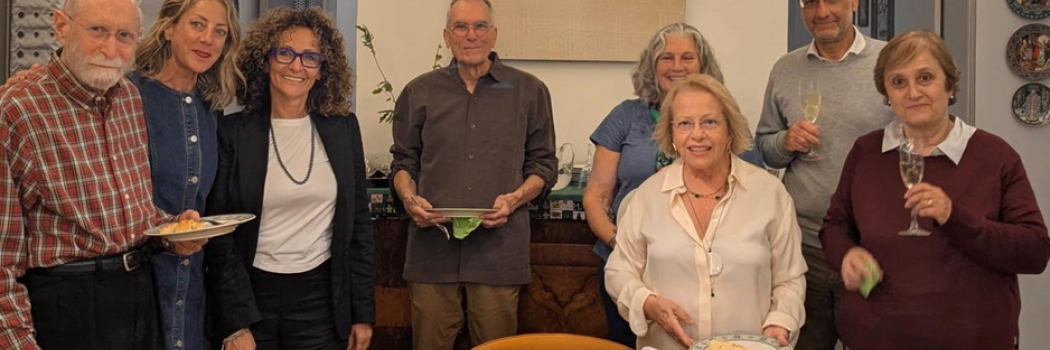
 Maria Lucia Luongo arranged an aperitivi with Seattle-Perugia Sister City Association (SPSCA) members and Comitato di Gemellaggio Perugia Seattle (Gemellaggio) members Olimpia, Lucio, Donatella and Lorena at her beautiful home. I was proud of our SPSCA members’ ability to maintain conversations in Italian. The Gemellaggio members are very friendly and easy to converse with. I look forward to the day they will come to Seattle and I will be able to spend more time with them. Below is a photo of the aperitivi table setting, my SPSCA colleagues and the Gemellaggio members in Maria Lucia’s home. Maria Lucia (wearing all white) made and served aperitivi drinks and snacks.
 I have had valuable and memorable experiences during my month in Perugia. This would not have happened to me if it were not for the generosity of the SPSCA. Thank you SPSCA for awarding me the scholarship and stipend to study in beautiful Perugia at Unistrapg, with its good instructors, beautiful architecture, and interesting international student body. It has been both an inspiring and pleasant place for me to improve my Italian. Alla fine, I feel like I am one lucky borsista.